
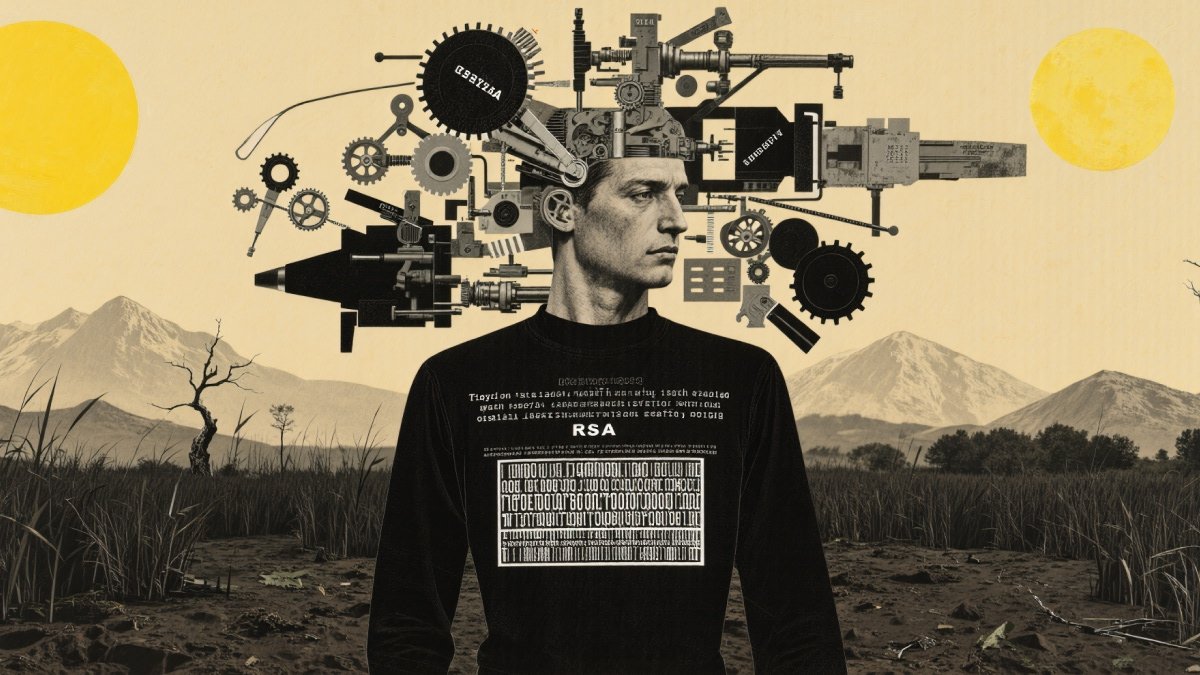
In 1995, a mathematician printed three lines of computer code on a t-shirt. The government told him that wearing it made him an arms dealer.
This sounds like a joke, but it isn’t. Under U.S. law at the time, that t-shirt was legally classified as a munition — right there on the same list as missiles and flamethrowers. The code implemented something called RSA encryption, which is what keeps your credit card information safe when you shop online. The government decided that sharing it was the same as selling weapons to foreign nations.
Why are we telling you this? Because the same fight is happening again right now, and it will affect the tools you use to run your business — whether you think of yourself as “tech-savvy” or not.
If you care about freedom, autonomy, and choosing your own business tools, you should be paying attention. You don’t need to understand how AI models are trained. You just need to understand that someone is trying to decide what software you’re allowed to use — and that has real consequences for your sovereignty as a business owner.
When Math Became a Munition
In the 1990s, the U.S. government treated strong encryption — the technology that makes private communication possible — as a military asset. If you wanted to publish an encryption algorithm, you would have had to register as an arms dealer and get government permission. Learn more about ITAR and the US Munitions List.
A group of mathematicians, engineers, and privacy advocates called the Cypherpunks fought back. They saw encryption as a tool for personal freedom, because the ability to communicate privately should be treated as a fundamental right — not a privilege granted by the government. They understood that the government’s rules here had a fatal flaw: the same information was being treated differently depending on whether it was printed on paper or saved to disk.
So they exploited that flaw. John Gilmore, an early internet pioneer, convinced MIT Press to publish the entire source code for an encryption program called PGP as a hardcover book — which the government had already admitted was protected speech — and shipped it to bookstores in Europe. Phil Karn, an engineer, again proved the absurdity of the government’s rules by getting approval to export a textbook containing encryption code, but denial to export the exact same code on a floppy disk.
Then a UC Berkeley math student named Daniel Bernstein sued the government for the right to publish his encryption algorithm. In 1996, a federal court ruled that source code is speech protected by the First Amendment. In 1999, the Ninth Circuit Court of Appeals affirmed: code communicates ideas with precision and rigor and the government cannot require a license to publish it.
Law professor Peter Junger won a parallel case in 2000, with the Sixth Circuit comparing code to musical scores and architectural blueprints: functional, yes, but also protected expression.
By 2000, the government retreated. Encryption was removed from the munitions list. The secure internet — online banking, private messaging, encrypted commerce — became possible because a handful of people refused to accept that their work was a weapon.
The Sequel: AI and the Same Old Fight
Last week, the Trump administration began considering an executive order to ban Chinese open-source AI models within the United States. The trigger was the release of Kimi K3 by Beijing-based Moonshot AI — a powerful AI system whose full code is scheduled to be released publicly on July 27, 2026, meaning any individual or company in the world with powerful enough hardware, will be able to run the model.
The administration is weighing restrictions including adding Moonshot to the Entity List, banning federal contractors from using the model, and issuing security warnings to discourage businesses from adopting it. Read more about the administration’s deliberations.
Here’s the core issue: once a model’s code is published online, you cannot put it back in the bottle. It becomes information, and information flows where it wants to go. The government knows this. So instead of trying to ban the file directly — which is nearly impossible to enforce — they are building a web of restrictions that make using the software legally risky and commercially unattractive.
Sound familiar? It should. It’s the same playbook they tried with encryption in the 1990s. And it failed then for the same reason it will fail now: you cannot control the distribution of information in a networked world without controlling the people who use it.
Why This Matters for Your Business
You might be thinking: I run a wellness practice. I teach children. I sell supplements. Why do I care about AI model weights?
Here’s why: the software you use to run your business — your email marketing platform, your customer relationship system, your content creation tools, your scheduling software — is increasingly powered by AI. Right now, the most powerful AI tools are controlled by a handful of massive corporations: OpenAI, Anthropic, Google, Microsoft. You access them through subscriptions, and you use them on their terms.
Open-source AI changes that equation. When an AI model is released with open weights (meaning the full code is published for anyone to use), a small business owner can download the same powerful technology that Fortune 500 companies use, run it on their own server, and never pay a subscription fee or share their customer data with a third party. It democratizes access. It puts you on equal footing with companies that have infinitely larger budgets.
If the government succeeds in restricting open-source models, the most powerful AI tools get locked behind corporate gates, and small businesses are left with whatever expensive, gated options the incumbents decide to offer them.
There’s more to it than cost. When you use a closed AI system, the company that built it decides how the model responds to your customers — what questions it will answer and what perspectives it favors. An open model lets you see those decisions and align your tools with your own values instead.
You deserve to choose your own tools. You deserve to know what software is doing with your customer data. You deserve access to open alternatives that align with your values of autonomy and transparency.
The Sovereignty Angle: Stack and Stance
At Sovryn Creative, we talk about business sovereignty as having two pillars: your stance (your mindset, your values, your commitment to freedom and autonomy) and your stack (the actual tools you use to run your business). Ideally, these two pillars work together to uphold your vision in a way that is effective, efficient, and values-aligned.
The fight over open-source AI is a fight over whether you will be allowed to build a sovereign stack. If the only AI tools available to you are corporate APIs that require you to send your customer data to a third party, you don’t have a sovereign stack. You have a rented tool that can change its terms, raise its prices, or disappear overnight.
The cypherpunks understood that sovereignty isn’t just an attitude — it’s a practice, and it relies on effective tools. They didn’t just believe in the right to encrypt their communications. They built the tools, published the code, and defended it in court. They treated their stack as an extension of their stance.
The Stakes Are Higher Than They Look
The legal question at the heart of this moment is whether the First Amendment protects AI model weights the same way it protected encryption source code in the 1990s. The courts have never ruled on this directly. As AI technology develops faster than the law can keep up, the next chapter of the free speech debate is being written in real time.
If the government establishes that it can restrict access to open AI models — whether through export controls, data center moratoriums, or liability frameworks — it will set a precedent that applies far beyond Chinese models. It will mean that your access to the software you use to run your business depends on government permission and corporate gatekeeping.
What Happens Next
We don’t know exactly how this will play out. The courts may extend the Bernstein and Junger precedents to protect AI model weights as speech. They may not. The administration may issue its executive order. It may back down under industry pressure. The 2028 election may bring a democratic socialist administration that approaches AI regulation through a completely different frame — not national security, but economic control.
What we do know is this: the same pattern repeats. A new technology emerges that threatens established power structures. The government tries to control it. A small group of stubborn people refuse to accept that their knowledge is dangerous. And eventually, if they persist, the information finds its way to the people who need it.
The Crypto Wars took a decade. The same fight is starting over AI. But the principle hasn’t changed. The tools you use to run your business should be aligned with your values, under your control, and yours to choose. No institution, no platform, no government should decide that for you.